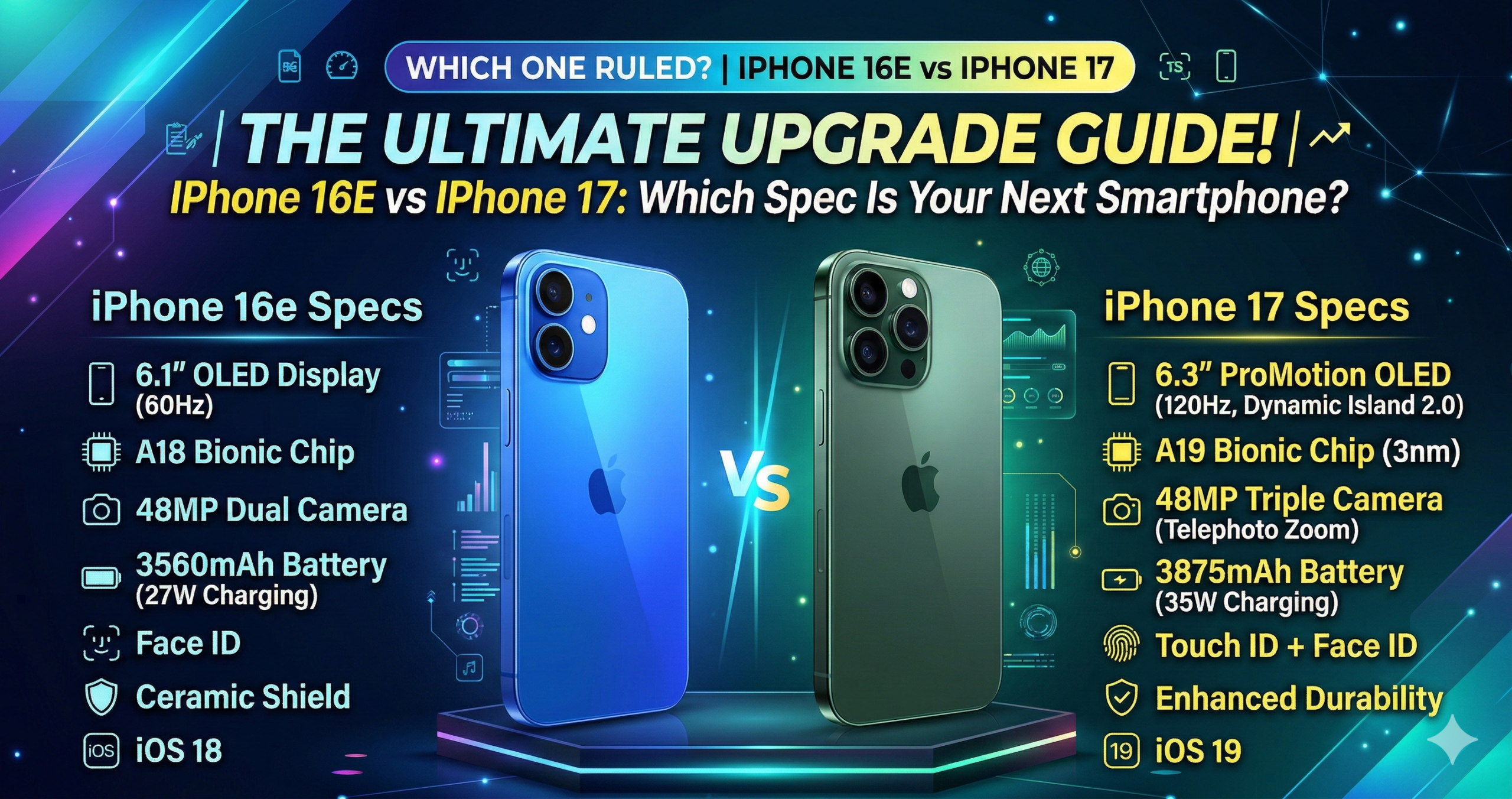
Are you debating between the iPhone 16 and the iPhone 17? With Apple’s rapid advancements in smartphone technology, choosing the right model can be tricky. In this detailed iPhone 16 vs iPhone 17 specs comparison, we’ll break down the key differences in design, display, performance, camera systems, battery life, and more. Whether you’re upgrading from an older iPhone or switching brands, this guide will help you decide which one offers better value in 2026. Note: Based on available information, “iPhone 16e” appears to be a potential typo or variant reference; we’ll compare the standard iPhone 16 and iPhone 17 models here.
Design and Build Quality
The iPhone 16 and iPhone 17 both feature Apple’s signature premium build, but there are subtle evolutions. The iPhone 16 measures 147.6 x 71.6 x 7.8 mm and weighs 170 grams, making it compact and lightweight. It comes in colors like Black, White, Pink, and Teal, with a Ceramic Shield front and an aluminum frame.
In contrast, the iPhone 17 is slightly larger at approximately 149.6 x 71.4 x 7.9 mm and 177 grams, offering a more substantial feel without being bulky. It introduces Ceramic Shield 2 for enhanced scratch resistance (up to 3x better than the iPhone 16) and an anti-reflective coating. Colors include sleek options like Black, with a focus on durability for everyday use. Both support IP68 water and dust resistance, but the iPhone 17’s refined design edges it out for long-term resilience.
Display Features
Display technology is a standout in this iPhone 16 vs iPhone 17 comparison. The iPhone 16 sports a 6.1-inch Super Retina XDR OLED display with a resolution of 2556 x 1179 pixels at 460 ppi. It includes Dynamic Island, HDR support, and peaks at 2000 nits brightness, but it’s limited to a 60Hz refresh rate, which might feel dated for smooth scrolling.
The iPhone 17 upgrades to a 6.3-inch Super Retina XDR OLED with 2622 x 1206 pixels at 460 ppi and ProMotion technology for adaptive refresh rates up to 120Hz. This means buttery-smooth animations, better for gaming and video. It also adds always-on display capabilities and higher peak brightness (up to 3000 nits outdoors), making it superior for outdoor visibility and multitasking.
| Feature | iPhone 16 | iPhone 17 |
|---|---|---|
| Screen Size | 6.1 inches | 6.3 inches |
| Resolution | 2556 x 1179 (460 ppi) | 2622 x 1206 (460 ppi) |
| Refresh Rate | 60Hz | Up to 120Hz (ProMotion) |
| Brightness | Up to 2000 nits | Up to 3000 nits |
| Additional Features | Dynamic Island, HDR | Always-On, Anti-Reflective Coating |
Performance and Software
Under the hood, the iPhone 16 is powered by the A18 chip with a 6-core CPU (2 performance + 4 efficiency cores), 5-core GPU, and 16-core Neural Engine. Paired with 8GB RAM, it handles demanding tasks like Apple Intelligence features and multitasking efficiently. It launched with iOS 18 and supports updates for years.
The iPhone 17 steps up with the A19 chip, also featuring a 6-core CPU but with improved efficiency and a potentially faster GPU for enhanced graphics. It maintains 8GB RAM but starts at higher base storage (256GB vs. iPhone 16’s 128GB). Running on iOS 19 (or later updates), it offers advanced Apple Intelligence tools like Clean Up and better integration with future features. Benchmark-wise, the A19 provides about 15-20% better performance in CPU-intensive tasks, making the iPhone 17 future-proof for AI and gaming.
Camera Systems
Camera upgrades are a key highlight in any iPhone specs comparison. The iPhone 16 features a dual rear setup: 48MP wide (f/1.6) with sensor-shift OIS and 12MP ultra-wide (f/2.2). It supports 4K video at 60fps, spatial photos, and a 12MP front camera. Great for everyday photography, but it lacks advanced telephoto options.
The iPhone 17 elevates this with a 48MP Fusion Main (f/1.6), 48MP Fusion Ultra Wide (f/2.2 with 4x resolution), and an implied 2x optical telephoto from the main sensor. The front camera jumps to 18MP with Center Stage for better video calls. It adds 4K 120fps Dolby Vision and macro capabilities, making it ideal for creators. Low-light performance and color accuracy see noticeable improvements.
Battery Life and Charging
Battery is crucial for all-day use. The iPhone 16 has a 3561 mAh battery, offering up to 22 hours of video playback. It supports MagSafe wireless charging (15W) and USB-C fast charging (up to 50% in 30 minutes with 20W adapter).
The iPhone 17’s 3692 mAh battery extends this to up to 30 hours of video playback and 27 hours streaming. It features faster charging (50% in 20 minutes with 40W adapter) and Qi2 wireless support. Efficiency from the A19 chip means better standby time, especially with always-on display.
Price and Availability
Pricing is a deciding factor in the iPhone 16 vs iPhone 17 debate. The iPhone 16 starts at around $799 for 128GB, making it more affordable for entry-level users.
The iPhone 17, released in September 2025, starts at $899 for 256GB, reflecting its upgrades. Both are widely available through carriers like T-Mobile, AT&T, and Verizon, with trade-in deals often bringing costs down.
Conclusion: Which Should You Buy?
In this iPhone 16 vs iPhone 17 specifications comparison, the iPhone 17 emerges as the winner for those seeking cutting-edge features like a 120Hz display, superior cameras, and longer battery life. However, the iPhone 16 remains a solid choice if you’re on a budget and don’t need the latest bells and whistles. Consider your needs— if photography and performance matter most, go for the 17. For everyday use, the 16 delivers excellent value.
If you’re searching for “iPhone 16 vs iPhone 17 specs” or “best iPhone comparison 2026,” this guide covers it all. Share your thoughts in the comments—which iPhone are you eyeing?